
Our product
A grounded AI engine that turns 15 hours of analysis into 2 minutes
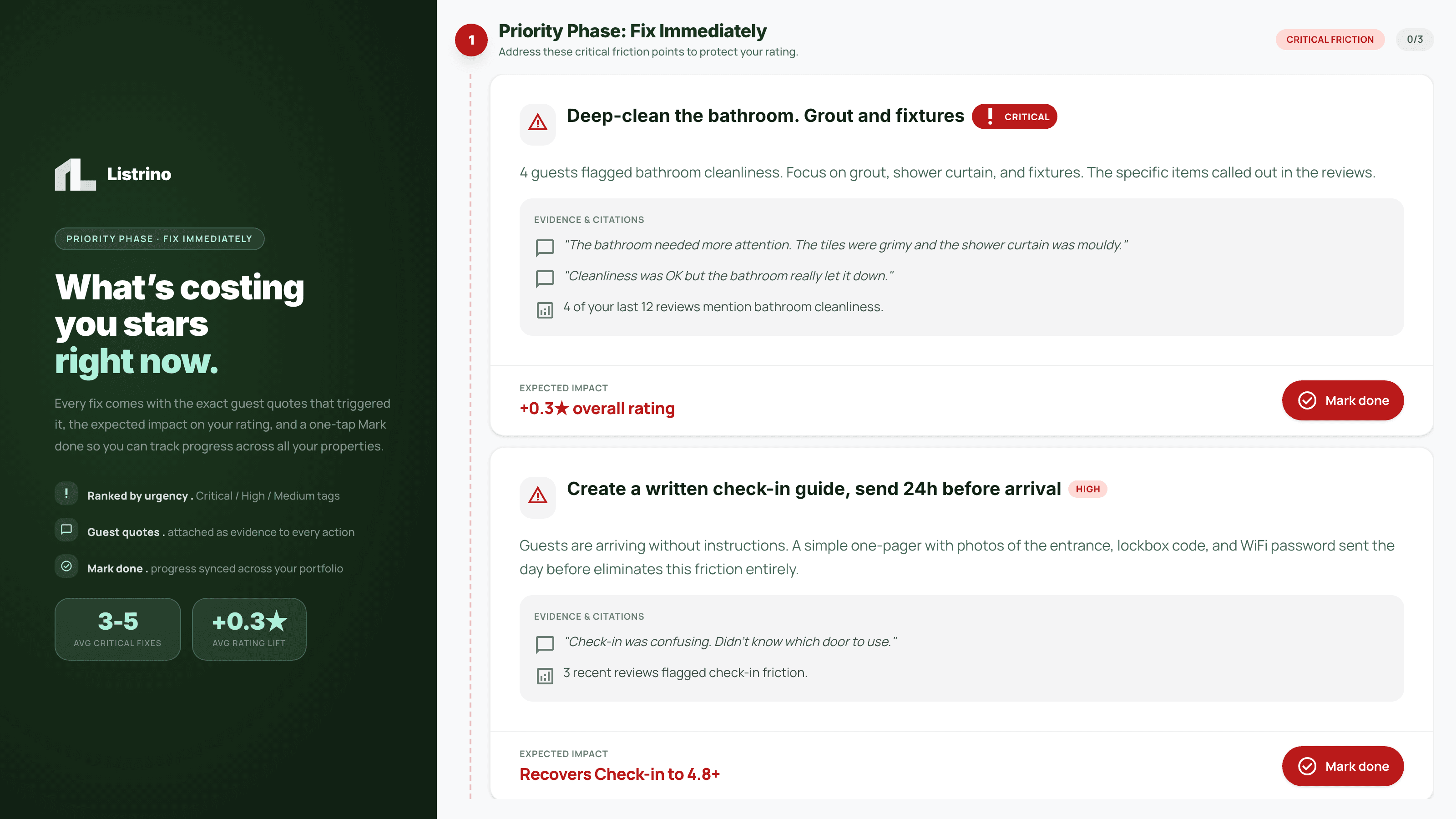
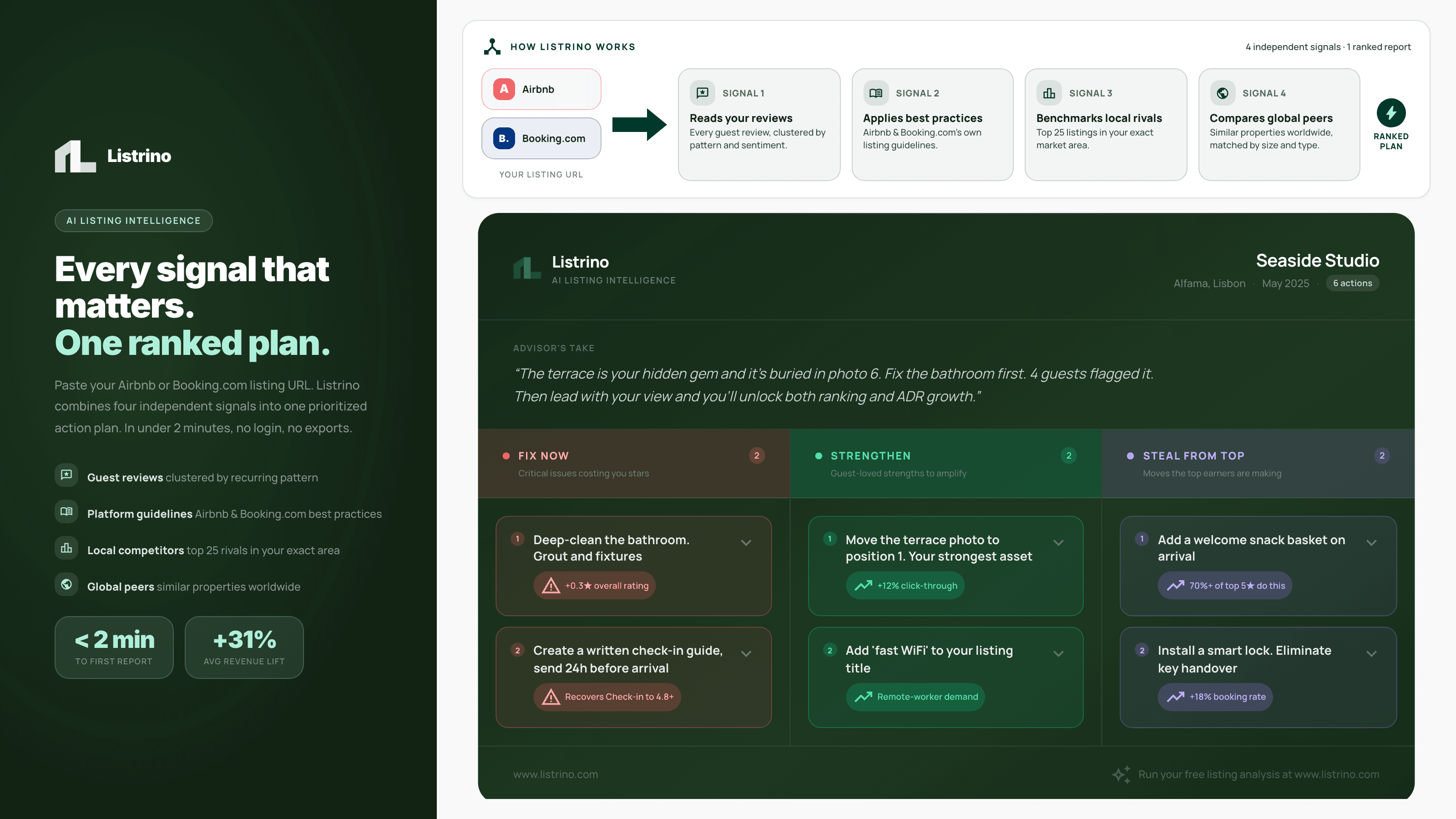
Listrino is our own AI SaaS for Airbnb and Booking.com hosts. We built an AI pipeline that combines scraped listing data, guest reviews, local competitors and platform guidelines into a ranked action plan, with every recommendation checked against its source before a user sees it.
- Client
- Listrino
- Industry
- Short-term rentals, SaaS
- Year
- 2026
Results
- < 2 minper report, down from 15+ hours of manual work
- 4data signals combined in one pass
- 0unsupported claims shown: items without evidence are dropped in code
The challenge
Airbnb and Booking.com hosts want to know one thing: what should I change to get more bookings? The answer is buried in dozens of reviews, competitor listings and platform rules. Doing this by hand took our founder more than 15 hours per property.
The obvious approach, sending everything to a language model and asking for advice, produced confident but generic output. Worse, early versions invented complaints that no guest had ever made. For a paid product, that was not acceptable.
Our approach
We treated the language model as one component in a pipeline, not as the whole product.
- Collect evidence. Apify scrapers fetch the listing, its reviews and a pack of top competitors in the same city and property type. Competitor packs are cached for 31 days and listing scrapes for 14 days to control cost.
- Extract themes into a fixed ontology. A small model maps review text to a predefined set of themes, with a regex fallback. No free-form summaries.
- Rank in code. Each potential action gets a severity and effort score in TypeScript, not in a prompt. Competitor gaps are measured, never assumed.
- Write with constraints. A writer model fills pre-selected slots with short, specific copy, routed between GPT-4o mini and GPT-4.1 mini by task.
- Verify and sanitize. A deterministic guard checks that every quoted complaint actually appears in the reviews and names the claimed problem. Anything unsupported is dropped. Invented unit counts or city names in suggested titles are blocked.
On top of the AI pipeline, we built a deterministic Listing Health Score, report history with deltas between runs, PDF export, public share links and portfolio views for multi-property hosts.
The results
- Full reports in under 2 minutes instead of 15+ hours.
- Recommendations hosts can trust, because each one shows the evidence behind it.
- Predictable costs: expensive vision models only run for paid users, and caching avoids repeat scraping.
What clients can take from this
The same pattern works for any AI product that must be right: support assistants, document analysis, compliance checks or sales research. Collect evidence, constrain the model, rank in code and verify before output. That is how we approach AI software development for clients.
Stack
- Next.js
- TypeScript
- OpenAI GPT-4o and GPT-4.1 mini
- Apify
- Neon Postgres
- Drizzle ORM
- Zod
- Vercel
Related work
 Our product
Listrino
An AI outbound engine that finds, analyzes and emails prospects on autopilot
We built a fully automated outbound pipeline for Listrino. It discovers hosts city by city, analyzes their listings with AI, scores each lead, publishes a personal audit, sends a two-step email sequence and stops follow-ups the moment someone replies.
1 person runs the full pipeline from the command line
Read case study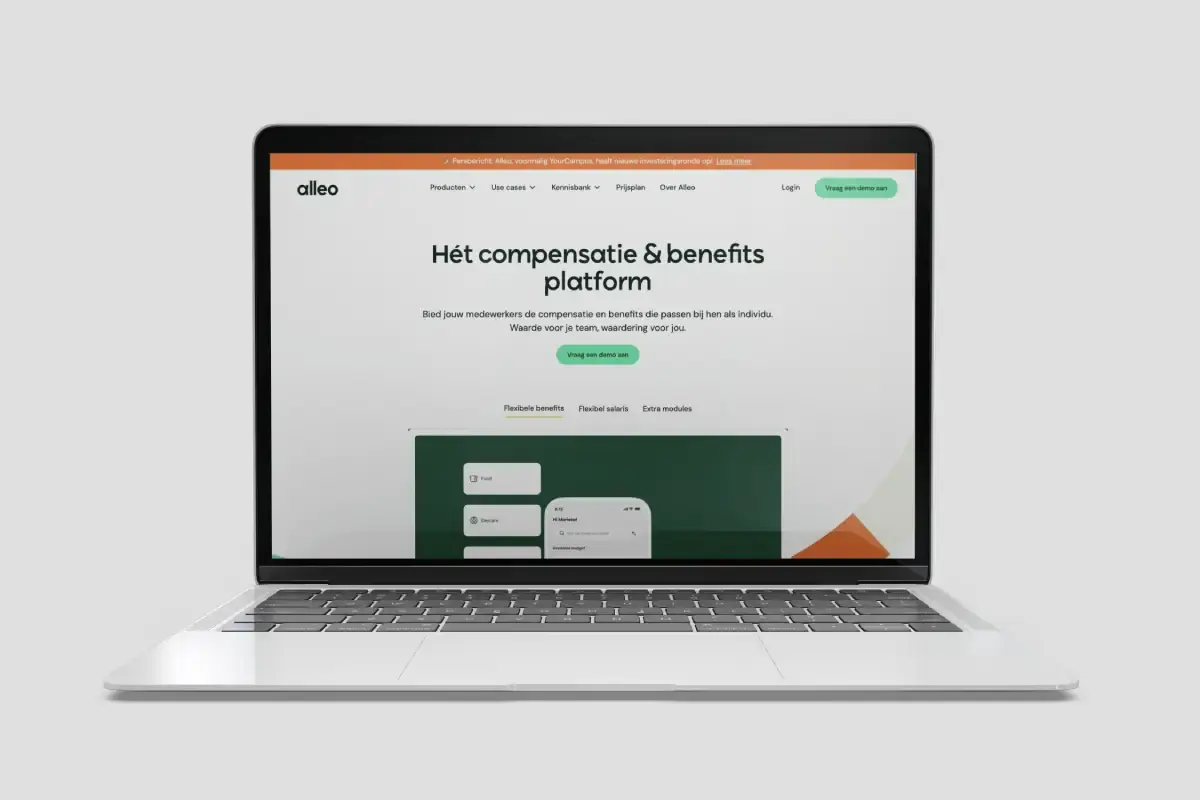 Client work
Alleo
A web and mobile compensation and benefits platform for Alleo
Alleo lets employers offer flexible, personalized benefits to their employees. We helped build the platform on web and mobile, with integrations into HR and payroll systems and options such as flexible salaries, tax savings and a benefits marketplace.
2 platforms shipped: web and mobile
Read case studyHave a project or an AI idea?
Tell us what you want to fix or build. We reply within one business day with honest next steps.